CEBRI advances at COP30 with events in the Blue Zone and begins activities at Casa Diálogo
- 12 november 2025
The Brazilian Center for International Relations (CEBRI) expanded its activities at COP30 with events held in the Blue Zone: the official venue for UNFCCC negotiations. The program at Casa Diálogo, CEBRI's temporary headquarters in Belém and a new meeting point for experts, policymakers, and civil society leaders, also began.
Casa Diálogo is a partnership between CEBRI and the Inter-American Dialogue, with support from the Climate and Society Institute (iCS) and sponsorship from Itaú, Vale, TIM, the Konrad Adenauer Foundation (KAS Brasil), and Syngenta. Located near the Blue Zone, it was created as a space to convert technical knowledge into concrete cooperation, connecting agendas for mitigation, adaptation, technology, and sustainable development.
12 de novembro
“Building Tipping Point Governance”
Organized by the Institutional Architecture Lab (TIAL), in co-organization with CEBRI, the University of Oslo, the Institute of Advanced Studies, and the University of São Paulo, the panel brought together scientists and leaders to discuss how global governance systems can respond to the risks associated with key tipping points in the Earth system, such as the stability of the Amazon and the North Atlantic Ocean circulation (AMOC).
Based on the concept note of the Global Tipping Points Report 2025, the meeting discussed proposals to structure a global network of Tipping Point Monitoring and Response Facilities (TEMRFs), reinforcing the role of science in building preventive mechanisms and warning systems capable of anticipating planetary risks.
Technology and Forests: Unlocking Innovation for Brazil's Climate Leadership
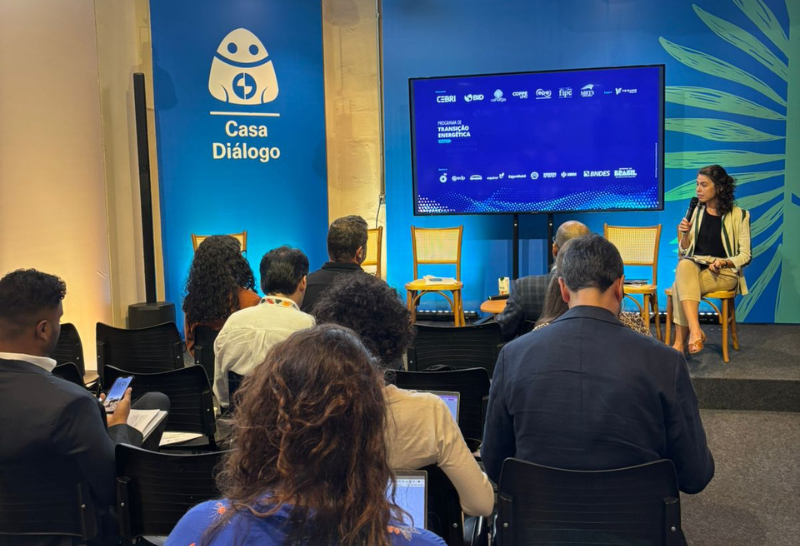
The first Casa Diálogo event, co-organized by CEBRI, the Tony Blair Institute (TBI), and the Rio Institute of Technology and Society (ITS Rio), brought together experts to discuss how emerging technologies, including artificial intelligence, forest monitoring platforms, geotechnologies, and innovative carbon credit models, can drive forest conservation and sustainable rural development.
Opened and moderated by Léa Reichert, Deputy Director of Projects at CEBRI, the panel welcomed André Oliveira, Climate Finance Advisor at TBI, Gabriella da Costa, Researcher at ITS Rio, Rogério Cavalcante, Founder of umgrauemeio, Grégory Maître, CEO of Morfo Brasil, Zé Gustavo Fávaro Barbosa Silva, Executive Director of the Brazilian Climatechs Forum, Henrique Dolabella, Director of the Rural Environmental Registry at the Ministry of Management and Innovation, Marianna Budaragina, Senior Climate Finance Advisor at TBI, and José Borges Frias Jr., Director of Corporate Innovation at Siemens.
In her speech, Léa emphasized that technology is essential for forest monitoring and energy transition. According to her, the country offers more investment opportunities and greater potential for positive impact on GDP than the global average.
Para que o país cumpra a meta da NDC até 2050, será necessário neutralizar as emissões de CO2 até 2040 e compensar, especialmente, as emissões de metano na agricultura e de carbono na indústria. A neutralidade climática depende diretamente do engajamento pleno desses setores, afirmou.
Léa também enfatizou o papel estratégico do setor de uso da terra (manejo do solo, sistemas agroflorestais e restauração), que pode gerar quase 1 milhão de empregos e impulsionar o PIB. Ela reforçou ainda a importância de fortalecer políticas de comando e controle para conter o desmatamento e viabilizar a neutralidade climática.
Gabriella da Costa (ITS Rio) emphasized that digital solutions must incorporate knowledge from local communities and presented AI monitoring initiatives, such as those conducted by the Kanindé People, Um Grau e Meio, Previsia (Imazon), and SEEG, as examples of innovation aligned with territorial reality.
Along the same lines, Rogério Cavalcante (Um Grau e Meio) highlighted that technology increases confidence in the carbon credit market and is essential for improving forest management. Grégory Maître (Morfo Brasil) presented end-to-end reforestation solutions, including drone seeding, digital monitoring, and the use of AI, which reduce costs and increase scale.
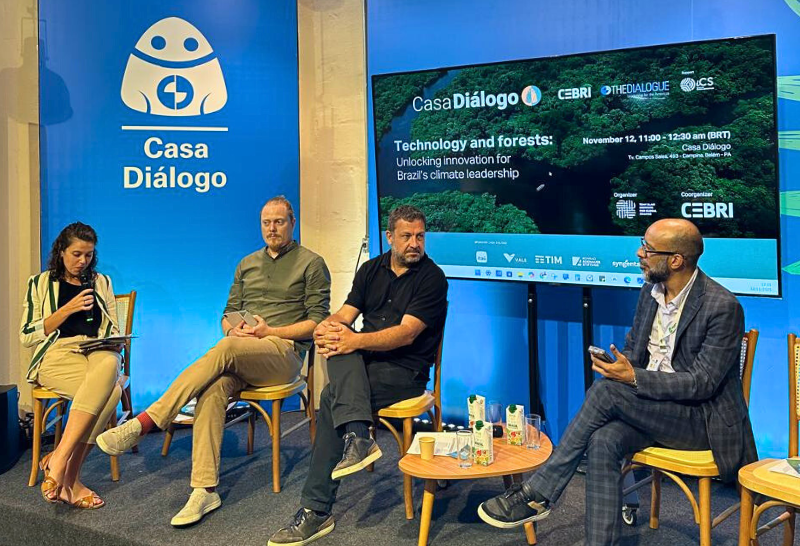
The debate also addressed the challenges of financing innovation. Zé Gustavo Fávaro Silva (Brazilian Climatechs Forum) pointed out the difficulty climate startups have in accessing capital after the first public rounds of FINEP and highlighted the lack of intermediaries capable of connecting entrepreneurs to financiers. For him, unlocking investment is essential for Brazil to exercise its enormous potential for leadership in climate technology solutions.
From an institutional point of view, Henrique Dolabella (Ministry of Management and Innovation) highlighted the role of the Rural Environmental Registry (CAR) as critical infrastructure for providing transparency and credibility to environmental data. He stressed that standardizing concepts, metrics, and databases is fundamental and should involve governments, companies, civil society, and international cooperation.
Finally, participants agreed on the importance of collaboration. Marianna Budaragina (TBI) emphasized that cooperation between governments, the private sector, and civil society—as well as between countries—is crucial for scaling solutions, especially in developing economies.
José Borges Frias Jr. (Siemens) reinforced that public-private partnerships are essential to advance at the necessary pace and highlighted the relevance of local nano-factories, which have a direct impact on communities and are better adapted to the specificities of forest ecosystems.
The panel concluded that the combination of technological innovation, multisectoral collaboration, and appropriate financial instruments will be crucial for Brazil to consolidate its climate and forestry leadership in the coming decades.
Leveraging COP Actions to Address Super Pollutants and Their Impacts on Air Quality
.png)
Held in the Super Pollutants Pavilion in the Blue Zone, the panel brought together international experts to discuss strategies for mitigating short-lived climate pollutants—such as methane, black carbon, and tropospheric ozone—that have an immediate impact on the climate, human health, and agricultural productivity.
Moderated by Thais Jesinski Batista, Deputy Director of CEBRI's Climate Transition and Sustainability Program, and opened by Jane Burston, CEO of the Clean Air Fund, the debate highlighted that reducing super pollutants is one of the fastest and most cost-effective ways to slow global warming; that many countries are advancing clean air policies driven by health and economic impacts; and that viable technologies already enable significant reductions in sectors such as waste, agriculture, transportation, and clean energy. The financing gap was also highlighted, with expectations for new commitments during COP30.
The panel also included:
- Izabella Teixeira, Member of CEBRI's International Advisory Board and former Minister of the Environment (2010–2016)
- Paulo Artaxo, Professor at USP, author of the IPCC and member of the COP30 Scientific Committee
- Marcelo Mena, CEO of Global Methane Hub
- Martina Otto, Deputy Director of the UNEP Division of Climate Change
In closing, Izabella Teixeira reinforced the importance of translating science in a simple and tangible way, connecting its results to people's lives in order to drive concrete action. She also highlighted that integrating climate, health, and air quality is essential to increase political, social, and economic engagement and accelerate high-impact measures.
The initiative is part of a project developed jointly by CEBRI and the Clean Air Fund to strengthen debates and actions on air quality ahead of COP30.
Click to learn more
.png)

