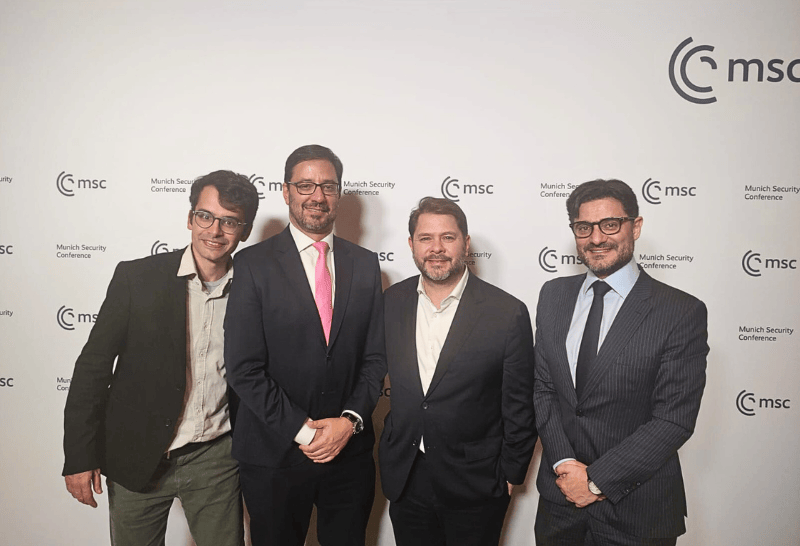
CEBRI Participates in the 62nd Munich Security Conference (MSC)
- 25 february 2026
Between February 13 and 15, 2026, the Hotel Bayerischer Hof in Munich hosted the 62nd Munich Security Conference (MSC), once again consolidating its role as one of the leading global forums for dialogue on international security. In a context marked by protracted conflicts, geoeconomic pressures, and accelerated technological transformations, the conference brought together heads of state, ministers, parliamentarians, representatives of international organizations, the private sector, and think tanks.
The program was structured around panels, conversations, and thematic sessions addressing the future of the international order, developments in the war in Ukraine, European and transatlantic security, strategic competition among major powers, and emerging issues such as artificial intelligence, space governance, climate security, and critical supply chains. President Volodymyr Zelenskyy took part in discussions on international support for Ukraine, underscoring the centrality of the conflict to the conference agenda.
Over the three days, regional dynamics in the Middle East, the Sahel, the Indo-Pacific, the Arctic, and the Americas were also debated, highlighting the interconnectedness between local challenges and systemic tensions. The panel "Western Hemisfever: Security in the Americas" brought together officials and experts to discuss security challenges in the continent, with the participation of U.S. Senator Ruben Gallego.
The Brazilian Center for International Relations (CEBRI) was represented by Feliciano Guimarães, Deputy Editorial Director, and Hussein Kalout, International Advisory Board Member. The Latin American delegation also included Héctor Cárdenas, President of COMEXI; Francisco de Santibañes, President of CARI; and Oliver Stuenkel, Senior Fellow at CEBRI and professor at FGV, reinforcing the region's presence in international strategic debates.
The 2026 edition reaffirmed the Munich Security Conference as one of the foremost forums for strategic dialogue in a world characterized by growing fragmentation and the redefinition of geopolitical balances. As highlighted in the Munich Security Report 2026, the international order is undergoing a period in which its foundational principles are being questioned, and strategic alliances are being reconfigured—dynamics reflected in much of the conference's debates. In a scenario where systemic disputes and regional conflicts intertwine with technological rivalries and geoeconomic pressures, the preservation of both formal and informal channels of dialogue remains essential to mitigate risks and prevent deeper ruptures in the international order.