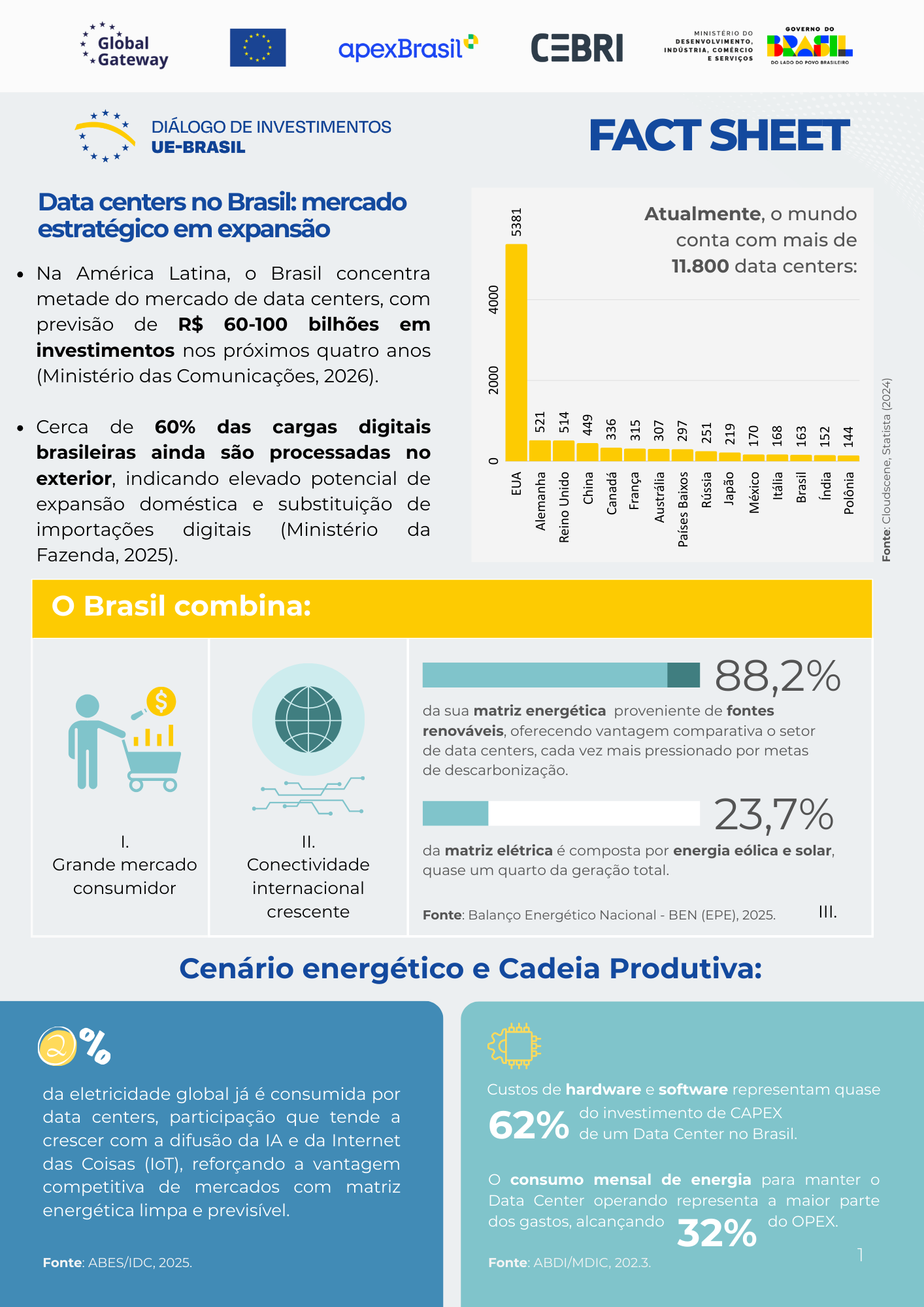
In the race toward digitalization, the appeal of data centers has risen on the Brazilian Government's investment agenda due to their central role in supporting cloud services, artificial intelligence, and large-scale data processing. Decisions regarding the installation of this type of infrastructure involve complex factors, including energy availability and cost, connectivity capacity, regulatory certainty, and territorial planning, as well as national incentive policies—most notably the Redata package, which stands out as a key fiscal instrument to stimulate the deployment and expansion of data centers in the country.
Within this context, the state of Ceará has shown itself to be receptive to attracting data centers, highlighting as competitive advantages the presence of submarine cables and development instruments such as the Digital Belt (Cinturão Digital) and Export Processing Zones. The critical challenge is to ensure that these infrastructures serve as drivers of local economic and technological development without compromising the population's access to essential resources, such as water and energy. To this end, investments must be guided by clear criteria and developed with partners that incorporate these concerns into their strategic planning.
It is against this backdrop that CEBRI is organizing a business meeting in Fortaleza within the framework of the European Union–Brazil Investment Dialogue, in partnership with APEX and the Delegation of the European Union. The panel will foster debate among the public sector, companies, and European investors to discuss concrete conditions for positioning Brazil on the global data economy map, taking into account opportunities, bottlenecks, and alignment pathways. The contributions from this meeting will inform the II Brazil–European Union Investment Forum, scheduled for March, where recommendations may be consolidated and presented to authorities, investors, and the press.
Fortaleza, Ceará
9:00 a.m to 1:00 p.m (BRT)
Portuguese
In the race toward digitalization, the appeal of data centers has risen on the Brazilian Government's investment agenda due to their central role in supporting cloud services, artificial intelligence, and large-scale data processing. Decisions regarding the installation of this type of infrastructure involve complex factors, including energy availability and cost, connectivity capacity, regulatory certainty, and territorial planning, as well as national incentive policies—most notably the Redata package, which stands out as a key fiscal instrument to stimulate the deployment and expansion of data centers in the country.
Within this context, the state of Ceará has shown itself to be receptive to attracting data centers, highlighting as competitive advantages the presence of submarine cables and development instruments such as the Digital Belt (Cinturão Digital) and Export Processing Zones. The critical challenge is to ensure that these infrastructures serve as drivers of local economic and technological development without compromising the population's access to essential resources, such as water and energy. To this end, investments must be guided by clear criteria and developed with partners that incorporate these concerns into their strategic planning.
It is against this backdrop that CEBRI is organizing a business meeting in Fortaleza within the framework of the European Union–Brazil Investment Dialogue, in partnership with APEX and the Delegation of the European Union. The panel will foster debate among the public sector, companies, and European investors to discuss concrete conditions for positioning Brazil on the global data economy map, taking into account opportunities, bottlenecks, and alignment pathways. The contributions from this meeting will inform the II Brazil–European Union Investment Forum, scheduled for March, where recommendations may be consolidated and presented to authorities, investors, and the press.