Reports
The São Paulo Charter on Artificial Intelligence Governance: Guidelines for Brazil and Latin America after the G20 Presidency
- tech
- 01 april 2026
The São Paulo Charter on Artificial Intelligence Governance is a multistakeholder policy document that outlines a strategic vision for responsible, inclusive, and innovation-driven AI governance in Brazil and Latin America.
Developed from discussions at the CEBRI International Seminar on AI Governance (São Paulo, August 2025), the Charter brings together perspectives from government, academia, civil society, and the private sector to propose a coordinated and forward-looking governance framework for artificial intelligence in the region.
Core Principles
The Charter establishes a set of guiding principles for AI governance:
- Human Rights and Inclusion: AI systems must promote equity and avoid discrimination
- Transparency and Explainability: Systems should be understandable, auditable, and accountable.
- Accountability Across the Value Chain: Responsibility must be shared among all actors involved.
- Risk-Based Regulation: Governance should be proportional to the level of risk.
- Adaptive and Participatory Governance: Policies must evolve with technology and include multiple stakeholders.
- Scientific Integrity and Data Quality: Reliable data and rigorous methods are essential.
- Environmental and Social Sustainability: AI development must consider environmental and societal impacts.
- International Cooperation: Global coordination is key to effective governance.
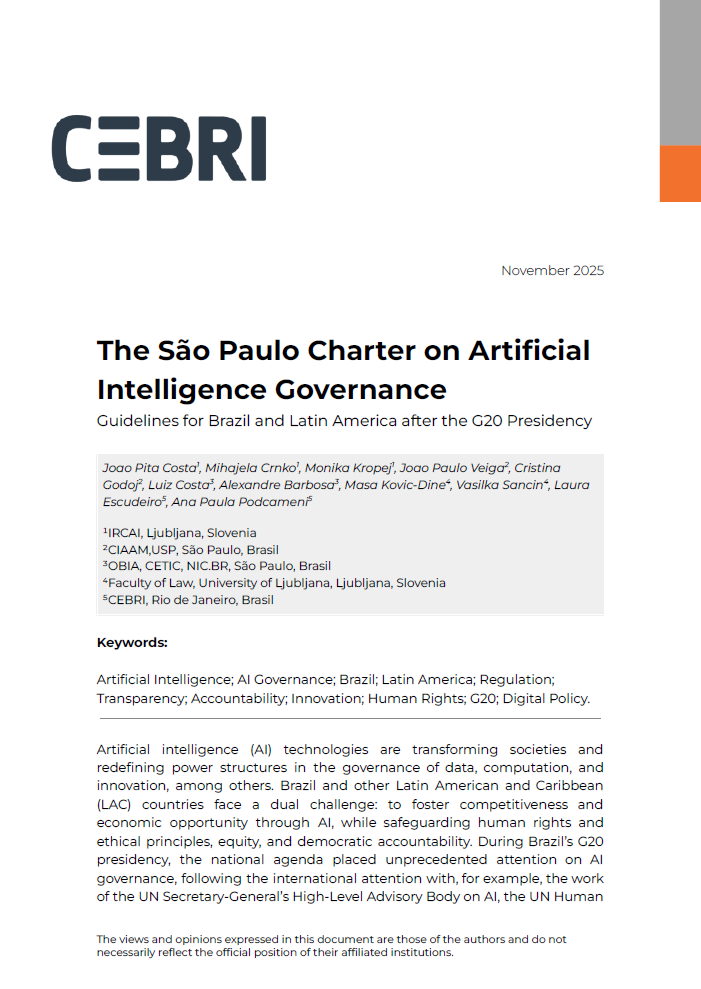

The São Paulo Charter on Artificial Intelligence Governance is a multistakeholder policy document that outlines a strategic vision for responsible, inclusive, and innovation-driven AI governance in Brazil and Latin America.
Developed from discussions at the CEBRI International Seminar on AI Governance (São Paulo, August 2025), the Charter brings together perspectives from government, academia, civil society, and the private sector to propose a coordinated and forward-looking governance framework for artificial intelligence in the region.
Core Principles
The Charter establishes a set of guiding principles for AI governance:
- Human Rights and Inclusion: AI systems must promote equity and avoid discrimination
- Transparency and Explainability: Systems should be understandable, auditable, and accountable.
- Accountability Across the Value Chain: Responsibility must be shared among all actors involved.
- Risk-Based Regulation: Governance should be proportional to the level of risk.
- Adaptive and Participatory Governance: Policies must evolve with technology and include multiple stakeholders.
- Scientific Integrity and Data Quality: Reliable data and rigorous methods are essential.
- Environmental and Social Sustainability: AI development must consider environmental and societal impacts.
- International Cooperation: Global coordination is key to effective governance.

66fea3e040367.png)