CEBRI at the Climate Innovation Zone: dialogue and strategy for climate implementation
- 10 november 2025
The Brazilian Center for International Relations (CEBRI) was present at the Climate Action Innovation Zone in São Paulo from November 6 to 8, 2025. The initiative, organized by the independent London-based organization Climate Action, sought to bring together global leaders from the business, financial, government, and civil society sectors to discuss the climate implementation agenda ahead of COP30 in Belém (PA).
CEBRI's participation included experts from the Environment, Climate Transition, and Energy agendas, integrating the main program of the Sustainable Innovation Forum and the Climate Implementation Summit, two spaces for dialogue on solutions and investments for the global low-carbon transition.
Sustainable Innovation Forum: innovation, strategic minerals, and energy transition
On November 6 and 7, the Sustainable Innovation Forum 2025 highlighted the role of the private sector in accelerating climate action. On the first day, Rafaela Guedes, Senior Fellow at CEBRI, and Clarissa Lins, Member of CEBRI’s International Advisory Board and co-founder of Catavento, participated in the panel “Critical Materials: Meeting Global Demand Responsibly,” which discussed the challenges of sustainable mining, traceability and transparency in production chains, and the role of innovation in the responsible supply of critical minerals.
During the debate, Clarissa Lins emphasized that “investors need regulatory predictability and an institutional environment that values transparency and the circular economy as foundations for long-term sustainability.”
.png)
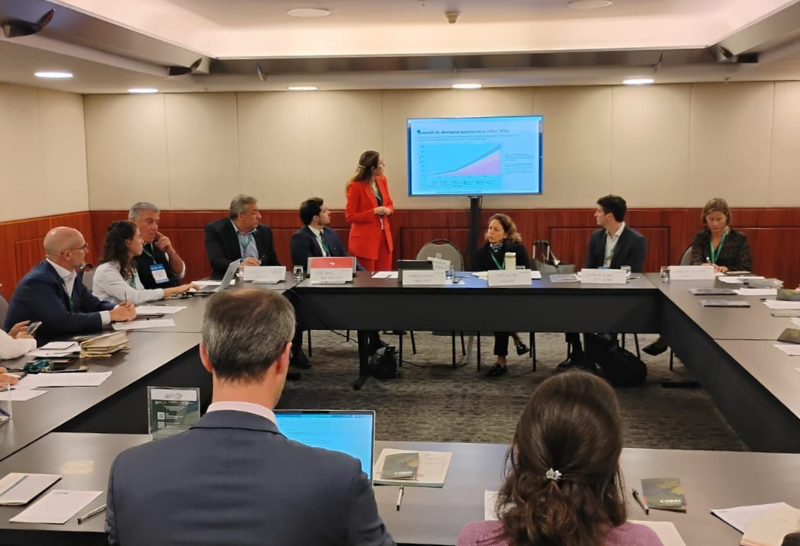
On the same day, CEBRI and the Brazilian Institute of Mining (IBRAM) hosted the roundtable "Sustainable Mining and Energy Transition: Unlocking Investments and Fostering Brazil's Potential in the Sector," which presented the Executive Report of the second phase of the Energy Transition Program (PTE).The study, conducted in partnership with Cenergia/COPPE/UFRJ, CETEM, and SGB, analyzes the impact of the energy transition on the demand for critical minerals until 2050 and Brazil's potential to meet global market needs.
The project is also in partnership with the Climate and Society Institute (iCS) and is sponsored by BHP and Vale, with institutional support from BMA Advogados. The session was moderated by Rafaela Guedes, who emphasized that “the energy transition requires regulatory and financial models capable of aligning the supply and demand for strategic minerals, with an emphasis on environmental responsibility and local value creation.”
The panel also highlighted the need to expand geological mapping, ensure adequate infrastructure, and promote transparent and predictable licensing—essential elements to unlock investments in sustainable exploration areas and attract capital for greenfield projects.
On the second day of the Forum, Izabella Teixeira, Member of CEBRI’s International Advisory Board and former Minister of the Environment and Climate Change of Brazil, participated as a keynote speaker.Em sua fala, Izabella destacou que “esta é a primeira COP em que o debate climático é tratado como uma questão do presente, não apenas do futuro”. In her speech, Izabella emphasized that "this is the first COP where the climate debate is treated as an issue of the present, not just the future."She stated that Brazil has a strategic position by integrating climate, biodiversity, and development into the global discussion — and needs to take an active role in building a new climate economy, based on connectivity, data security, and smart information management.
The former minister also pointed out that the country "has included climate in the agenda of the G20 and BRICS+, with the goal of providing concrete solutions and rebuilding the pillars of leadership and global trust."
Climate Implementation Summit: the COP of Implementation
.png)
Closing the participation of CEBRI, the Climate Implementation Summit held on November 8 reinforced Brazil's role in the "Implementation COP." The event was co-organized by the Climate and Society Institute (iCS), Converge Capital, and Climate Action, and it featured representatives from the COP30 presidency, finance ministers, and international leaders.
During the panel “From the Paris Agreement to the Decade of Implementation,” Izabella Teixeira emphasized that “global leadership needs to be renewed: the private sector and science must take on political roles.” She proposed a paradigm shift (from energy transition to resource transition), linking discussions on economy, power, and sustainability. According to Izabella, “the valuation of the Amazon, through the Forever Tropical Forest Fund (TFFF), connects forests, minerals, and power, paving the way for a new economy based on bioeconomy, circularity, and regenerative models.”
The presence of CEBRI in the Climate Innovation Zone reaffirms the role of the think tank as a space for articulating technical knowledge and strategic dialogue, in line with its mission to position Brazil at the center of global climate action.
