
-

-

-
 PT | EN
PT | EN 
Donald Trump’s return to the White House became the main systemic variable shaping domestic and external dynamics in Argentina under the government of Javier Milei and in Brazil under the government of Luiz Inácio Lula da Silva. In a context of increased U.S. involvement and influence in Latin America, while Argentina pursued alignment with Washington’s interests and received a substantial “carrot,” Brazil faced “sticks” and deepened its hedging strategy. An analysis of these strategies and their initial outcomes is the main objective of this essay.
The presidential elections in the United States have always been an important systemic variable for Latin America, given the centrality of Washington for the international insertion of the countries in the region. This dynamic has been accentuated over the last decade as US foreign policy has become more government-driven than State-driven, following the rupture of bipartisan consensus on the US's role in the world (Kanji 2025). Washington has become more volatile and unpredictable in its external actions (Yarhi-Milo 2025).
For the governments of Javier Milei in Argentina and Lula da Silva in Brazil, the results of the November 2024 elections in the United States marked a turning point in terms of external permissibility (Jaguaribe 1979). Donald Trump's decisive triumph over Kamala Harris, on the one hand, empowered and oxygenated the political project of the libertarian government in Argentina, and on the other, became a restrictive and adverse force for the domestic and external interests of the government of the former metallurgical leader in Brazil.
This perception of the differing effects on Buenos Aires and Brasília, held prior to Trump taking office (Actis 2024a), was largely confirmed over the first year of the Trump II administration, as the trajectory of White House actions unfolded. The implementation of the Trump Corollary to the Monroe Doctrine (Winter 2026) not only entailed greater pressure and influence across the so-called Western Hemisphere (Romero et al. 2025) but also constituted open interference in the internal affairs of Latin American states (Carothers & Stuenkel 2025).
In this context, this essay aims to analyze the dynamics of the bilateral relationship between the United States and Argentina and Brazil—from January 2025 to January 2026—and to conduct a partial, comparative evaluation of the strategies pursued by Buenos Aires and Brasília, as well as their outcomes.
ARGENTINA'S ALIGNMENT STRATEGY: “CARROTS” AND LATENT VULNERABILITY
Since December 2023, Javier Milei's government has pursued a clear strategy of alignment (Russell & Tokatlian 2013), marked by the subordination of foreign policy to its relationship with the United States and a clear pullback from regional policy. The coupling strategy pursued by several Latin American governments in the 1990s was the status quo of the international order, the so-called pax americana. However, since the intensification of questioning of the "rules-based order" originates from the White House itself, the Milei administration supports and contributes, from the periphery, to the erosion of multilateralism and of an institutionalized international society. There is a critique rooted in the ideology of the alt-right (Merke & Pereira Doval 2024) towards the functioning of the liberal international order/institutionalism, whose closest Latin American antecedent was the experience of Brazil under Bolsonaro's government (Casarões & Barros Leal 2022). In that context, the Milei government has supported, and at times overplayed, various foreign policy actions to curry favor with Washington. For example, at the CELAC-China Summit held in May 2025 in Beijing[1], Argentina sent a third-line representative and was the only country to decline to sign the final declaration[2].
Argentina's alignment with Trump II is evident in Milei's international trips and in voting patterns at the United Nations General Assembly. In 2025, Milei traveled to the US 7 times (30% of his departures from the country) and, for example, has not visited Asia since becoming President. The report 'Voting Practices in the United Nations 2024' from the Department of State (2025) indicates that in the UN General Assembly, Argentina voted with the US on 82% of occasions. One must go back to 1962 (in the context of the Cuban Revolution) to find such a high level of voting alignment between Argentina and the United States. Although there are no official data for 2025, it is expected that, with Trump in the White House, this percentage will exceed 90%.
Unlike other attempts at alignment between Argentina and the United States, such as those during the governments of Carlos Menem (1991–1999), the Milei administration received one of the few "carrots" that Trump II extended to the region amid multiple "sticks" (Eurasia Group 2026): a heterodox reward, namely Treasury Secretary Scott Bessent's decision to do "whatever it takes" to prevent a currency run in Argentina in the lead-up to the country's midterm elections in October 2025. In addition to allowing a currency swap, the Treasury directly intervenes in the currency market by purchasing pesos[3] to stabilize the country's currency amid currency crises. devaluation and high domestic risks (Setser & Paduano 2025). At the bilateral meeting Milei held at the White House in October 2025, as well as during Bessent's visit to Buenos Aires, it became evident that Milei and his political circle have access to Trump and his top officials.
Both Argentina and Brazil were subject to a 10% baseline tariff increase in early April 2025 as part of "Liberation Day." However, their paths diverged in the second half of the year. While Trump imposed 40% tariffs on Brazil and clashed with Lula and Brazilian institutions, Argentina began negotiating a trade agreement (White House 2025a) that already has a framework[4] with commercial commitments. The document notes the existence of an Economic Security Alignment and a framework to facilitate trade and investment in critical minerals. Under the Biden administration, Milei's government signed an MoU with the United States to strengthen cooperation in critical minerals (US Mission Argentina 2024). In a context of geoeconomic fragmentation (Aiyar et al. 2023) and the search for secure supply chains, Argentina—like Brazil—gains relative importance.
However, the Milei government's alignment strategy is not with the United States as such, but with the Trump administration—hence its main vulnerability. Argentina lacks a lender of last resort[5], which has led to the unusual provision of financial assistance from the US Treasury. Until the country regains access to international markets (through a significant decline in country risk), both the economic model and its political strength rest on expectations of a bailout from Scott Bessent. Democratic Party lawmakers have expressed opposition to financial assistance (Sánchez 2025), demonstrating that Milei's government is part of the strong political polarization currently experienced in Washington[6]. A potential electoral defeat of Trump and the Republicans in the 2026 midterms could alter the balance of power in Washington and, therefore, recalibrate the type of support and instruments toward a country like Argentina. In such a scenario, the Argentine government has no plan B.
BRAZIL AND HEDGING: “STICKS” AND NEGOTIATING RESILIENCE
Biden and Lula developed a presidential-level synergy between 2023 and 2024, due to their domestically polarized political agendas, despite important divergences on specific issues (Hirst & Valls Pereira 2024). The Biden administration played a decisive role in discouraging the attempted coup d’état backed by Bolsonarism in January 2023. Trump's return to the White House represented a challenge both to the clear hedging strategy in foreign policy implemented by Lula III (Kalout & Sá Guimarães 2022; Spektor 2023) and to his domestic political strategy, given the external empowerment it provided to the Bolsonaro family.
The bifurcation of external strategies between Argentina and Brazil became very clear from 2025 onwards. Under Lula III, Brazil opted to reinforce its multi-alignment strategy, seeking to diversify its foreign and trade relations as much as possible to avoid pressure from major powers, a strategy further reinforced by Trump's return (Stuenkel 2025). In 2025, Brazil's President undertook three trips to Asia (March, May, October), visiting Japan, Vietnam, China, Indonesia, and Malaysia.
Unlike Argentina, where the government secured access to the White House, in Brazil, it was the circle around Eduardo Bolsonaro that achieved a rapprochement from January 2025. Tariff measures and sanctions against Alexandre de Moraes, a justice of Brazil's Federal Supreme Court (STF), can be partly explained by this lobbying capacity. In late July 2025, Brazil received Trump's "sticks"[7], with the particularity that the demands were not commercial but rather domestic: to influence Brazilian institutions in the judicial process against Jair Bolsonaro.
In the face of the White House's onslaught, Lula's government remained firm in both its rhetoric and its threat of retaliation[8]. Unlike other actors that quickly entered negotiations with Trump from a position of weakness (such as the European Commission), Lula understood that Trump's demands were impossible to meet, but that, at its core, Washington had long-term strategic interests in an actor that falls into the category of a Geopolitical Swing State (Cohen 2023; Actis 2024b), where there was room for negotiation. Brazil's disadvantage—stemming from the lack of personal rapport between the presidents (an element present in Argentina under Milei)—was offset by Brazil's structural weight in the hemisphere, consistent with the traditional notion of a Pivotal State (Chase, Hill & Kennedy 1996).
Brazil's strategic reserves of rare earths (still largely untapped) have become a central issue in the bilateral relationship amid the United States' efforts to reduce its dependence on China. At the same time that Foreign Minister Mauro Vieira has sought to open channels of dialogue with Trump's officials (especially Marco Rubio), Brazil's business sector has exercised the lobbying capacity that the government itself has lacked vis-à-vis Trump and the White House. For example, Joesley Batista, the Brazilian tycoon of Grupo J&F—who contributed to Trump's campaign—served as a conduit for bringing Trump and Lula closer (Magalhães 2026). Tariffs on Brazilian beef represented a significant blow to JBS, a firm with deep penetration in the US market. The lobbying capacity of Brazilian companies vis-à-vis the White House has not been present in Argentina, revealing their relative weakness in the multilatinas phenomenon. For instance, the Argentine company Techint was never able to secure export quotas for steel and aluminum amid Trump's tariff increases on those goods.
The bilateral meeting between Trump and Lula in Malaysia (October 2027) marked a new phase in the relationship, opening a round of negotiations that culminated in Trump's modification of the tariffs imposed[9] and the removal of sanctions against Alexandre de Moraes. Unlike Argentina, where trade negotiations are oriented toward a broad agreement, Brazil's deal consisted of a rollback of tariff measures, without additional trade commitments. At the same time, Brasília and Washington began to explore avenues for cooperation on rare earths, which could culminate in a bilateral agreement in 2026 (Pooler, Hodgson & Stott 2026). It is worth recalling that in August, the Development Finance Corporation (DFC) approved a $465 million loan for the Serra Verde mine in Goiás—the only producing rare earths operation in Brazil—as well as a $5 million disbursement for feasibility studies (Bloomberg 2025). In times of geoeconomic fragmentation, minerals become a strategic asset for Brazil and much of South America.
FINAL REFLECTIONS
Donald Trump's return to the White House became the main systemic variable shaping the political trajectories of Argentina and Brazil, with implications for both their domestic arenas and their international positioning. Considering the interpersonal ties forged (with Milei and Bolsonarism) and the centrality of Latin America in the foreign policy of Trump's new administration (something not seen in Washington since the 1980s), there is no precedent in the 21st century of a first year of a US presidency exerting such influence over the political, economic, and international trajectory of Buenos Aires and Brasília. In turn, this variable clearly became a centrifugal force in the bilateral relationship between South America's two principal countries, as antagonistic perceptions intensified (Actis 2025).
In this context, the present essay seeks to highlight the divergence in the trajectories of the Milei and Lula governments vis-à-vis Trump's United States, based on the analysis of different indicators, which are summarized in the following table:
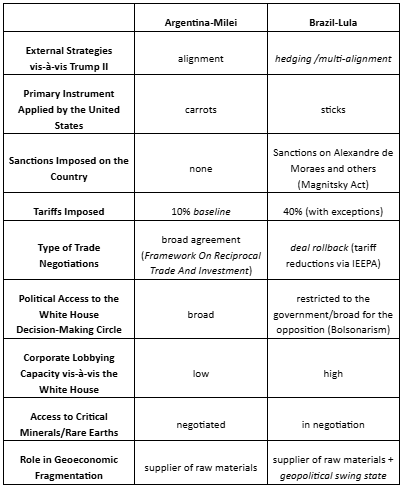
Table 1: Comparative summary of the governments of Milei and Lula against Trump II
Overall, this study shows clearly how the systemic variable under analysis became permissive for the Milei government and restrictive for the Lula government. However, beyond leveraging its alignment strategy to secure bilateral financial support (the major "carrot" Trump offered to a country in the region), Argentina continues to face political and economic vulnerabilities that are far from resolved, given its lower structural weight in the international system. For its part, Trump's "sticks" toward Lula came at a cost. However, the deepening of hedging, an accurate reading of negotiating capacity, the role of the private sector, and Brazil's condition as not only a provider of key raw materials—like Argentina—but also an actor with weight in the context of great power competition (a geopolitical swing state), have given it resilience in the face of an adverse international environment.
Notes
[1]Milei’s government cooled its political relationship with China, but not its economic and trade ties. Unlike other emerging economies that sought to curb the oversupply of Chinese goods amid Trump’s renewed trade war, Argentina was among the countries that most increased imports from China, while significantly liberalizing foreign trade.
[2]Other examples include Argentina’s dissociation from the UN “Pact for the Future” in September 2024; the withdrawal of its delegation from COP29 in Baku, Azerbaijan, in November 2024; the decision to withdraw the Argentine Republic from the World Health Organization (WHO) in February 2025; and Milei’s absence from the G20 Summit in South Africa in November 2025.
[3]Since 1971, the U.S. Treasury has intervened directly in foreign exchange markets of third countries on four occasions: Japan (1998 and 2011), the European Union (2000), and Argentina (2025).
[4]From the outset of his administration, Milei has sought to negotiate a free trade agreement (FTA) with the United States through a flexibilization of MERCOSUR—an approach not supported by Trump’s mercantilist vision. Given the constraints in Washington, Argentina has instead pursued a partial agreement that includes not only tariff-related commitments (such as exceptions to MERCOSUR’s Common External Tariff, CET) but also non-tariff issues, including intellectual property, access to natural resources, trade facilitation, and digital trade, among others.
[5]Argentina already has an active IMF program and maintains a swap line with the People’s Bank of China—both considered sources of last-resort financing, typically accessed when market financing becomes unavailable.
[6]The exchange on X between Treasury Secretary Scott Bessent and Senator Elizabeth Warren (October–November 2025) centered on a currency swap of up to US$20 billion from the U.S. Treasury (via the Exchange Stabilization Fund) to support the Milei government. Warren repeatedly denounced it as a political “bailout” for a Trump ally, benefiting hedge funds and Wall Street while neglecting domestic U.S. priorities (affordable healthcare, affected farmers, and the risk of a government shutdown). She called for transparency, criticized the lack of disclosure, and sought to block it (including through proposed legislation such as the “No Argentina Bailout Act”).
[7]Trump described the trial against Bolsonaro as a “witch hunt” and used sanctions as a tool of pressure (including economic and personal sanctions under the Global Magnitsky Act), alongside 40% tariffs on Brazilian exports (via the IEEPA), in an effort to influence Brazil’s Supreme Federal Court (STF). The objective was to protect U.S. interests and support Bolsonaro, who was sentenced to 27 years in prison by the STF in September 2025.
[8]Lula threatened retaliatory measures and explicitly invoked the possibility of applying the Economic Reciprocity Law (also referred to as the Commercial Reciprocity Law).
[9]A broad list of agricultural products (238 HTSUS codes plus 11 additional categories) was excluded from the additional 40% tariff, including coffee, tea, tropical fruits and juices, cocoa, spices, bananas, oranges, tomatoes, beef, coconut water, açaí, and others. These products are now subject only to the 10% baseline tariff (or less, where prior preferences or exemptions apply, such as under Section 232 in some cases) (White House 2025b).
References
Actis, Esteban. 2024a. “La Argentina y Brasil frente a un Trump 2.0.” Panamá, 7 de novembro de 2024. https://panamarevista.com/la-argentina-y-brasil-frente-a-un-trump-2-0/
Actis, Esteban. 2024b. “Tironeados por los ‘dos Nortes’: el lugar de los geopolitical swing states en un orden internacional fragmentado y en disputa.” Asuntos Globales CARI 1 (468): 145-155. https://cari.org.ar/uploads/articles/CARI_468_ESP.pdf.
Actis, Esteban. 2025. “El vínculo bilateral Argentina-Brasil. Hacia la búsqueda de amortiguadores en un escenario de percepciones antagónicas y mermado poder de negociación.” La inserción de la Argentina en el mundo CARI 10 (788): 4-32. https://cari.org.ar/uploads/articles/CARI_788_ESP.pdf.
Aiyar, Shekhar et al. 2023. “Geoeconomic fragmentation and the future of multilateralism.” IMF Staff Discussion Notes 001. https://doi.org/10.5089/9798400229046.006.
Attwood, James & Mariana Durão. “US backs Serra Verde’s Brazilian rare-earth project with $465 million funding.” Bloomberg, 7 de novembro de 2025. https://www.bloomberg.com/news/articles/2025-11-07/us-backs-serra-verde-s-brazilian-rare-earth-project-with-465-million-funding.
Carothers, Thomas & Oliver Stuenkel. 2025. “U.S. political interventionism under Trump. Carnegie Endowment for International Peace.” Carnegie Endowment for International Peace, 24 de setembro de 2025. https://carnegieendowment.org/research/2025/09/us-political-interventionism-under-trump?lang=en.
Chase, Robert S., Emily B. Hill & Paul Kennedy. 1996. “Pivotal States and U.S. Strategy.” Foreign Affairs 75(1): 33-51. https://doi.org/10.2307/20047466.
Cohen, Jared. 2023. “The rise of geopolitical swing states.” Goldman Sachs, 15 de maio de 2023. https://www.goldmansachs.com/insights/articles/the-rise-of-geopolitical-swing-states.
Eurasia Group. 2026. “Top Risks 2026.” Eurasia Group Report, 5 de janeiro de 2026. https://www.eurasiagroup.net/issues/top-risks-2026.
Hirst, Monica & Lia Valls Pereira. 2024. “Lula 3.0 e as relações do Brasil com os Estados Unidos.” Nueva Sociedad. https://www.nuso.org/articulo/EP2024-lula-relacoes-brasil-estados-unidos/
Jaguaribe, Helio. 1979. “Autonomía periférica y hegemonía céntrica.” Estudios internacionales 12 (46): 91-130. https://doi.org/10.5354/0719-3769.1979.16458.
Kalout, Hussein & Feliciano de Sá Guimarães. 2022. “Hedging Between the U.S. and China: Brazil Protecting Itself to Survive.” CEBRI-Journal 1 (4): 18-36. https://cebri.org/revista/en/artigo/57/hedging-between-the-us-and-china-brazil-protecting-itself-to-survive.
Kanji, Kamil. 2025. “Fractured Consensus : Domestic Polarization and the Erosion of U.S. Global Leadership.” University of British Columbia Thesis. http://dx.doi.org/10.14288/1.0448663.
Magalhaes, Luciana Novaes. 2026. “Exclusive: Brazil billionaire Batista shuttles between DC and Caracas, eyeing oil deals.” Reuters, 14 de janeiro de 2026. https://www.reuters.com/business/energy/brazil-billionaire-batista-met-with-venezuelas-rodriguez-us-officials-2026-01-14/.
Pooler, Michael, Camilla Hodgson & Michael Stott. 2026. “Brazil and US eye rare earths deal.” Financial Times, 18 de janeiro de 2026. https://www.ft.com/content/401a9e84-3034-4375-bf39-56b92500c7aa.
Romero, Carlos A., Carlos Luján, Guadalupe González, Juan G. Tokatlian & Mónica Hirst. 2025). “Trump y América Latina y el Caribe: ¿un laboratorio de control?” Nueva Sociedad. https://nuso.org/documento/trump-y-america-latina-y-el-caribe-un-laboratorio-de-control/.
Russell, Roberto, & Juan G. Tokatlian. 2013. “América Latina y su gran estrategia: entre la aquiescencia y la autonomía.” Revista CIDOB d'afers internacionals 104: 157-180. https://www.redalyc.org/articulo.oa?id=695776922008.
Sánchez, Linda. 2025. “Sánchez, Sewell lead 54 Democrats demanding answers on $20 Billion Argentina Bailout.” Press Release, 21 de outubro de 2025. https://lindasanchez.house.gov/media-center/press-releases/sanchez-sewell-lead-54-democrats-demanding-answers-20-billion-argentina.
Setser, Brad & Stephen Paduano. 2025. “Other people’s money, and the problem with Mileism.” Financial Times, 30 de setembro de 2025. https://www.ft.com/content/5f4bb8d6-e93c-4bf0-b0ae-f459255eb8c7.
Spektor, Matias. 2023. “In defense of the fence sitters: What the West gets wrong about hedging.” Foreign Affairs 102 (3): 8-16. https://www.foreignaffairs.com/world/global-south-defense-fence-sitters.
Stuenkel, Oliver. 2025. “Multi-alignment as strategy: How Brazil navigates between Washington, Beijing, and the Global South.” Belfer Center for Science and International Affairs, 20 de novembro de 2025. https://www.belfercenter.org/research-analysis/multi-alignment-strategy-how-brazil-navigates-between-washington-beijing-and.
US Department of State. 2025. “Voting Practices in the United Nations, 2024.” U.S. Department of State, 11 de julho de 2025. https://www.state.gov/voting-practices-in-the-united-nations-2024/.
U.S. Mission Argentina. 2024. “US and Argentina Sign Memorandum of Understanding to Strengthen Cooperation on Critical Minerals.” U.S. Embassy in Argentina, 23 de agosto de 2024. https://ar.usembassy.gov/us-and-argentina-sign-memorandum-of-understanding-to-strengthen-cooperation-on-critical-minerals/.
Winter, Brian. 2026. “What history tells us about Trump’s ‘big stick’.” Americas Quarterly, 15 de janeiro de 2026. https://www.americasquarterly.org/article/what-history-tells-us-about-trumps-big-stick/.
White House. 2025a. “Joint Statement on Framework for a United States - Argentina Agreement on Reciprocal Trade and Investment.” The White House, 13 de novembro de 2025. https://www.whitehouse.gov/briefings-statements/2025/11/joint-statement-on-framework-for-a-united-states-argentina-agreement-on-reciprocal-trade-and-investment/.
White House. 2025b. “Modifying the Scope of Tariffs on the Government of Brazil.” Executive Orders, 20 de novembro de 2025. https://www.whitehouse.gov/presidential-actions/2025/11/modifying-the-scope-of-tariffs-on-the-government-of-brazil/.
Yarhi-Milo, Karen. 2025. “The price of unpredictability: How Trump’s foreign policy is ruining American credibility.” Foreign Affairs, 2 de outubro de 2025. https://www.foreignaffairs.com/united-states/price-unpredictability
Submitted: January 24, 2026.
Accepted for publication: January 27, 2026
DOI: https://doi.org/10.54827/issn2764-7897.cebri2025.16.02.07.111-122.en
* Translated by Victoria Corrêa do Lago with the support of digital machine translation tools: Google Translate (initial draft), Grammarly (grammatical and syntactic revision), and ChatGPT (selective phrasing refinements). Reviewed by the author.
Copyright © 2026 CEBRI-Journal. This is an Open Access article distributed under the terms of the Creative Commons Attribution License, which permits unrestricted use, distribution, and reproduction in any medium, provided the original article is properly cited.
