
-

-

-
 PT | EN

Brazil has built large-scale agriculture on a strong dependence on imported nutrients. The National Fertilizer Plan 2022-2050 estimates that approximately 85% of the fertilizers used in the country come from abroad and projects that dependence will remain high in 2050 (Brazil 2022). For phosphate fertilizers, risk stems not only from imports but from the interaction among product-level concentration, the crop calendar, freight, ports, and shocks that may affect suppliers and routes simultaneously.
This article advances the debate developed by CEBRI’s Agro Hub. The policy paper by Pinto et al. (2022) treated fertilizer dependence as a source of exchange-rate and logistics exposure. In November 2025, the Hub’s event on fertilizer geopolitics again linked commercial intelligence, strategic diplomacy, and resilience (CEBRI 2025). The next step is to disaggregate the problem: Monoammonium Phosphate (MAP), Diammonium Phosphate (DAP), Triple Superphosphate (TSP), Single Superphosphate (SSP), phosphate rock, and phosphoric acid have distinct markets, suppliers, and risks.
The argument is that nominal diversification is insufficient. Supply security requires conditional redundancy: an additional source must offer an available product, relative independence from the same bottlenecks, activation within the crop calendar, an acceptable delivered total cost, and socio-environmental continuity. Foreign policy can reduce information asymmetries and organize tests; it cannot replace decisions by buyers, banks, insurers, and logistics operators.
CONCEPT AND METHOD
Conditional redundancy is a decision rule applied to resilience. Diversification describes the existence of more than one origin; resilience describes the capacity to absorb and recover from shocks; real-options analysis explains the value of preserving choices under uncertainty (Christopher & Peck 2004; Dixit & Pindyck 1994). The redundancy proposed here exists only when the alternative is technically compatible, commercially actionable, and exposed to risks that do not fully replicate those of the main supplier. Two sellers dependent on the same input, port, or critical route may expand the supplier list without improving security.
The unit of analysis is the six-digit Harmonized System (HS) product. The research uses data reported by Brazil and Tunisia to UN Comtrade, as well as government and company sources on capacity and projects. The series distinguishes actual imports, exports, projected capacity, and commercial supply. Morocco serves as the scale benchmark. Tunisia is a test case selected because of bilateral dialogue and a concrete business proposal, not because it is assumed to be the world’s second-best supplier. The conclusion therefore does not automatically extend to other exporters. The case tests the Tunisian option currently available to bilateral policy and commercial dialogue; it does not rank all possible origins. A broader comparison of alternative exporters belongs to a subsequent stage of commercial intelligence.
The measurement has three limitations. First, HS 310311 and 310319 are proxies: commercial TSP and SSP cargoes may differ in nutrient concentration, granulation, moisture, and agronomic performance. Second, customs data record completed trade, not idle capacity, contractual commitments, or the volume a producer could mobilize during a disruption. Third, the Tunisian export quantities for 2024 are marked as estimated in UN Comtrade and cannot be treated as evidence of availability in 2026. The figures are therefore suitable for screening and case selection, but not for a bankable supply decision. That requires recent shipment records, product certificates, plant-availability data, and a firm offer aligned with Brazil’s agricultural calendar. Trade data were extracted from UN Comtrade on 17 September 2026 and measured by reported net weight. The Herfindahl-Hirschman Index (HHI) is the sum of squared origin shares by volume on a 0-10,000 scale; HS 251010 and HS 251020 were aggregated for phosphate rock. The use of 2025 Brazilian data and 2024 Tunisian data reflects the latest available year for each reporter at extraction. Statements of no recorded flow indicate absence from the selected reporter-product-year dataset, not proof that no transaction occurred.
The authors work at the Embassy of Brazil in Tunis and have followed public sources and non-confidential discussions on the issue. This access is used to formulate questions and identify actors, not as evidence of capacity. The authors have no financial ties to the companies examined, and the inclusion of Groupe Chimique Tunisien does not constitute an institutional or commercial endorsement. Feasibility claims depend on public data, verifiable documents, and independent due diligence. The views expressed are personal and do not necessarily represent the Ministry of Foreign Affairs or the authors’ institutions.
BRAZILIAN DEMAND BY PRODUCT
The 2025 data show sizeable and concentrated markets. Brazil imported 3.14 million tonnes of MAP and mixtures, 3.22 million tonnes of other superphosphates–used here as a proxy for SSP–and 1.70 million tonnes of superphosphates containing at least 35% P2O5 (Phosphorus Pentoxide), used as a proxy for TSP. In all six groups examined, the three largest origins accounted for more than 84% of volume. The composition nevertheless varies: Russia led MAP, Egypt led SSP, Morocco led TSP and phosphoric acid, and Peru led phosphate rock (UNSD 2026).
Disaggregation changes the diplomatic priority. Tunisia supplied Brazil with 33.3 thousand tonnes in the TSP category in 2025, or 2.0% of Brazilian imports of that product, and only 0.1 thousand tonnes of MAP. No flows of SSP, DAP, phosphoric acid, or phosphate rock were recorded. The relationship already has a foothold in TSP, but it does not yet demonstrate redundancy in SSP.
Concentration indicators are a screening device, not a verdict on vulnerability. A high HHI may coexist with reliable supply, while a lower index may conceal correlated exposure to the same shipping corridor, energy shock, or upstream input. Product-level intelligence should therefore combine market shares with delivery windows, port and route dependence, contractual flexibility, quality specifications, and the time required to qualify an alternative product. For seasonal agriculture, an option that arrives after the application window is not operational redundancy. This is why the diplomatic task is not simply to identify another flag of origin, but to verify whether the alternative can perform under a defined disruption scenario.
For buyers, the relevant comparison is the delivered cost per unit of usable nutrient, not merely the free-on-board price per tonne. The calculation should include P2O5 content, product consistency, ocean freight, insurance, financing, port handling, storage, demurrage risk, inland transport, and any adjustment required for blending or field application. A pilot should compare a Tunisian cargo with a benchmark shipment under the same technical protocol and record laboratory conformity, rejected lots, lead-time variance, documentary performance, and final delivered cost. This makes the test useful to procurement departments and prevents a favorable diplomatic narrative from masking an uneconomic or technically unsuitable transaction.
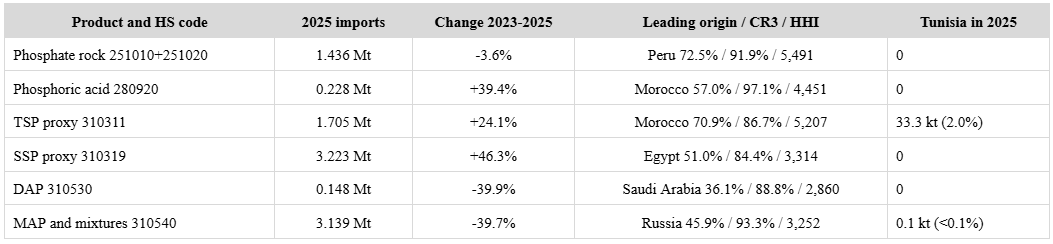
Table 1 - Brazilian imports of phosphate inputs by product. Source: Authors’ calculations using UN Comtrade data (UNSD 2026). CR3 is the share of the three largest origins. HHI is the Herfindahl-Hirschman Index, from 0 to 10,000, calculated by volume. Categories 310311 and 310319 are used as proxies for TSP and SSP.
MOROCCO AS SCALE AND TUNISIA AS TEST
Morocco occupies a structural position. Under the United States Geological Survey (USGS) statistical convention, which aggregates Morocco and Western Sahara under the Moroccan heading, the combined territory holds approximately 50 billion tonnes of phosphate rock reserves, around 68% of the estimated world total (USGS 2026). OCP integrates mining, processing, and logistics (OCP Group 2025). This scale makes Morocco indispensable, but it does not eliminate the value of complementary origins.
Tunisia combines an established industrial base with capacity in phosphate rock, phosphoric acid, and fertilizers. In 2024, UN Comtrade recorded estimated Tunisian exports of 127.9 thousand tonnes in the TSP category, 1.1 thousand tonnes of SSP, 223.6 thousand tonnes of DAP, and 28.0 thousand tonnes of MAP and mixtures (UNSD 2026). The Mdhilla 2 project was designed for 400 thousand tonnes of TSP per year, but projected capacity is not the same as stabilized production or uncommitted volume available for contract (Tunisia 2022).
In August 2026, Groupe Chimique Tunisien (GCT) expressed interest in discussing long-term supplies of SSP and TSP, a logistics platform at a Brazilian port, and studies on fertilizer blending and formulation in Brazil (Brazil 2026). The documentation examined does not specify volumes. Before any mission or financial support, GCT would need to submit a written offer by product, including specifications, available annual volume, shipping window, port, delivery record, and commercial terms.
For Tunisia, the phosphate chain is not only an export sector. Its economic and environmental stakes are territorially concentrated: an official mining project in Gafsa is linked to downstream supply and projected employment, while recent African Development Bank environmental and social audits cover GCT sites in Gabès, Skhira, and Mdhilla (Tunisia n.d.; AfDB 2025). This industrial footprint carries an environmental legacy that no external contract can resolve on its own. A relationship limited to purchasing low-priced tonnage would not alter this equation and is unlikely to be durable. Tunisian operators have a different interest in cooperation with Brazil: contractual predictability that can support plant rehabilitation beyond short price cycles; technical cooperation and conditional financing tied to environmental modernization rather than volume alone; and market diversification. From the Brazilian side, the practical consequence is that Tunisia should not be treated as a low-cost supplier of last resort, activated only during shocks. A credible option requires a stable relationship under minimum operating conditions, combined with verified delivery performance.
The distinction between a structural supplier and an option supplier is central to the portfolio logic. Morocco can support base-load procurement because scale, integration, and established logistics permit large and recurrent flows. Tunisia does not need to replicate that scale to add value. Its contribution would arise from maintaining a qualified product, a tested route, and a contractual channel that can expand within a defined period when another source or corridor is disrupted. A small origin is not automatically a useful backup: the option has value only if it is sufficiently independent, commercially alive in normal times, and capable of increasing deliveries without excessive cost. This is why an initial TSP flow matters more as evidence of operability than as a change in Brazil’s aggregate import dependence.
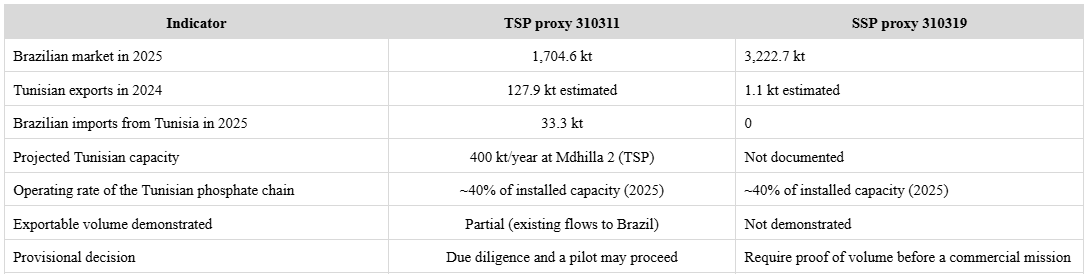
Table 2 - Minimum application of conditional redundancy. Source: Authors’ calculations using UN Comtrade data (UNSD 2026). Tunisian export volumes for 2024 are marked as estimated in the database; Brazilian flows for 2025 are reported by Brazil.
SUSTAINABILITY AND OPERATIONAL CONTINUITY
Sustainability is not an external constraint on the phosphate trade; it is a condition for reliable supply. Mining, rock washing, sulfuric acid production, phosphoric acid processing, atmospheric emissions, water consumption, fluoride compounds, and phosphogypsum accumulation can generate social conflict and operational interruption. In Gabès, allegations of pollution from the phosphate complex have fueled recent social mobilization (Reuters 2025). For a Brazilian buyer, the relevant mechanism is continuity: untreated environmental liabilities increase the probability of shutdowns, delays, remediation costs, and reputational exposure, and therefore reduce the value of the option.
Due diligence should be proportional to the stage: an inventory of permits, water use, emissions, waste, and interruption history before a mission; a verifiable baseline and corrective plan before a pilot; and independent audits, measurable targets, and suspension clauses before financing or any long-term contract. Environmental performance is thus part of supply-security assessment, not a separate reputational requirement.
A 24-MONTH DECISION ROADMAP
Implementation should separate public facilitation from private risk. Brazil’s Ministry of Foreign Affairs can coordinate the external track with the Ministry of Agriculture and Livestock and the Ministry of Development, Industry, Trade and Services, while informing the National Fertilizer Council. Potential buyers include importers and trading companies, domestic producers and blenders, cooperatives, and purchasing centers. Port operators, insurers, banks, and laboratories enter according to the stage. No category should be presumed interested before direct consultation.
The criteria below prevent diplomatic affinity from preceding feasibility. The first decision is product-specific: the data justify due diligence and a possible pilot in TSP. For SSP, the process should remain at the intelligence stage until there is evidence of regular exportable supply. A commercial pilot should be designed to produce decision-grade information, not to maximize immediate volume. Buyers should determine a volume that is small relative to the Brazilian market but large enough to expose operational weaknesses before any scaling decision. The test should cover product conformity, delivery within the crop calendar, complete documentation, insurance and financing arrangements, port regularity, environmental compliance, and delivered cost per unit of P2O5 against an agreed benchmark. Results should be assessed against pre-agreed criteria on a fixed review date. Before the pilot begins, participating buyers should set thresholds for each criterion. The option qualifies as conditional redundancy only if all technical, temporal, documentary, economic, and socio-environmental gates are jointly met.
Pre-pilot technical assistance may support diagnosis, audit, product specification, and a corrective plan. Investment financing should come only after commercial and operational evidence. Public or development-finance participation may be justified when it removes a specific bottleneck–for example, environmental modernization, equipment reliability, or logistics that support a verified contract–rather than when it substitutes for absent demand. Any facility should be disbursed in stages and linked to delivery, environmental, and governance milestones. Foreign-policy support should likewise be reversible: a failed pilot should close the path to scale until deficiencies are corrected, while a successful pilot may support expansion on verified performance rather than diplomatic expectation. This sequencing protects public credibility, keeps market risk with the parties best placed to assess it, and allows cooperation to deepen only when the Tunisian option has demonstrated value for Brazilian supply security.
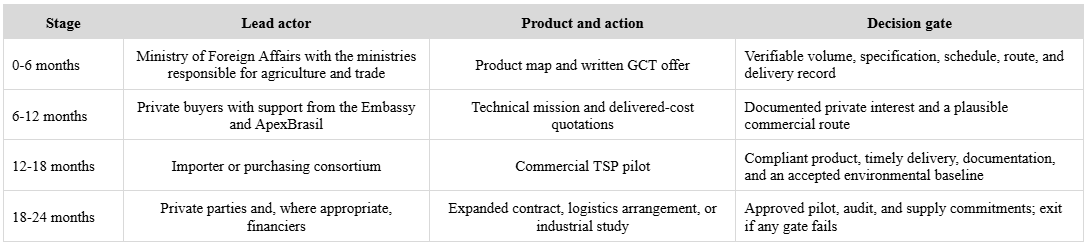
Table 3 - Institutional sequence and decision gates. Source: Authors’ proposal. Timelines are indicative and assume voluntary participation by private actors.
CONCLUSION
Brazilian phosphate fertilizer diplomacy should manage persistent dependencies. Product-level research shows that vulnerability is not uniform and that Tunisia already has a limited presence in TSP, but has not yet demonstrated the proposed SSP option. The policy gain lies not in announcing a new supplier but in testing a bilateral hypothesis against observable criteria.
If a written offer, private interest, a pilot, and due diligence are approved in sequence, Tunisia may add a modest layer of redundancy to Brazil’s portfolio without attempting to replace Morocco. If any gate fails, the initiative should be suspended or redesigned. This discipline turns cooperation into a real option and preserves public resources for projects capable of delivering within the crop calendar and under sustainable socio-environmental conditions.
References
African Development Bank (AfDB). 2025. ‘Tunisia - Support Project for Groupe Chimique Tunisien (P-TN-BB0-010).’ Environmental and social assessments for the Gabès, Skhira, and Mdhilla sites, 28 July 2025. https://www.afdb.org/en/documents/tunisie-projet-dappui-au-groupe-chimique-tunisien-p-tn-bb0-010.
Brazil. 2022. National Fertilizer Plan 2022-2050. Brasília: Ministry of Agriculture and Livestock. https://www.gov.br/agricultura/pt-br/assuntos/insumos-agropecuarios/insumos-agricolas/fertilizantes/plano-nacional-de-fertilizantes.
Brazil. Ministry of Foreign Affairs. 2026. Telegram no. 00313 from the Embassy of Brazil in Tunis, 18 August 2026. ‘Tunisia. Phosphate fertilizer diplomacy. Groupe Chimique Tunisien. Cooperation with Brazil. Analysis.’ Unpublished official document, authors’ files.
CEBRI. 2025. ‘Global Geopolitics of Fertilizers: Impacts on Brazilian Agribusiness.’ Agro Hub event, 26 November 2025. https://cebri.org/br/evento/987/geopolitica-global-dos-fertilizantes-impactos-sobre-o-agronegocio-brasileiro.
Christopher, Martin, and Helen Peck. 2004. ‘Building the Resilient Supply Chain.’ The International Journal of Logistics Management 15 (2): 1-14.
Dixit, Avinash K., and Robert S. Pindyck. 1994. Investment under Uncertainty. Princeton: Princeton University Press.
OCP Group. 2025. Annual Financial Report 2024. Casablanca: OCP Group.
Pinto, Amanda Araújo, Camila Dias de Sá, Claudia Cheron König, and Marcos Sawaya Jank. 2022. Public Policies for the Competitive and Sustainable Integration of Brazilian Agribusiness into the World. Rio de Janeiro: CEBRI, Agro Hub. https://cebri.org/media/documentos/arquivos/PolicyPapersAGRO.pdf.
Reuters. 2025. ‘Once an Idyll, Tunisian Protest Hotspot Gabes Now an Environmental “Nightmare”.’ 20 October 2025. https://www.reuters.com/sustainability/climate-energy/once-an-idyll-tunisian-protest-hotspot-gabes-now-environmental-nightmare-2025-10-20/.
Tunisia. Ministry of Industry, Mines and Energy. n.d. ‘Oum Lakhcheb Phosphate Project.’ Accessed 1 October 2026. https://www.energiemines.gov.tn/fr/themes/mines/developpement-des-ressources-minieres/phosphate/projets-et-etudes/oum-lakhcheb/.
Tunisia. Ministry of Industry, Mines and Energy. 2022. ‘Mdhilla 2 Project: Project Brief.’ General Directorate of Mines. https://www.energiemines.gov.tn/fileadmin/docs-u1/Projet_TSP_M_Dhilla2_2022.pdf.
UNSD (United Nations Statistics Division). 2026. UN Comtrade Database. Brazilian imports for 2023-2025 and Tunisian exports for 2023-2024, HS 251010, 251020, 280920, 310311, 310319, 310530, and 310540. Accessed 17 September 2026. https://comtradeplus.un.org/.
USGS (United States Geological Survey). 2026. Mineral Commodity Summaries 2026: Phosphate Rock. Reston, VA: USGS. https://pubs.usgs.gov/periodicals/mcs2026/mcs2026.pdf.
Submitted: October 2, 2026
Accepted for publication: November 3, 2026
Copyright © 2026 CEBRI-Journal. This is an Open Access article distributed under the terms of the Creative Commons Attribution License, which permits unrestricted use, distribution, and reproduction in any medium, provided the original article is properly cited.
