
-

-

-
 PT | EN
PT | EN 
Contemporary international relations constitute a complex system with political, military, economic and sociocultural dimensions that give rise to constant shifts and profound uncertainties. The prevailing understanding of these relations has been shaped over more than a century by a handful of European countries and the United States. But these are no longer the sole points of reference; authors from the so-called Global South are challenging and expanding traditional perspectives (Acharya 2025, 351-353).
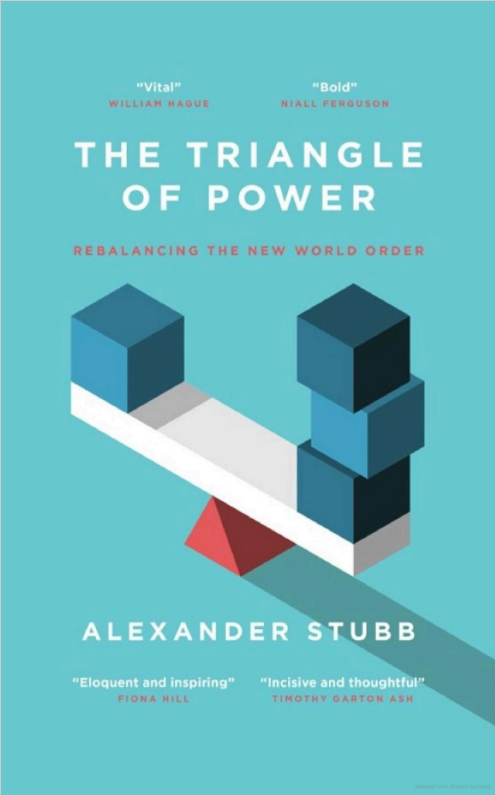
It is within this more cosmopolitan landscape that Alexander Stubb, an academic and professional politician, currently President of Finland, finds himself. Finland, whilst not a country of the South, was, as the author explains, colonized. During the Second World War, Finnish nationalism waged a two-phase struggle (1940-1941 and 1941-1944) against Moscow and lost part of its territory.
During the Cold War, it maintained a delicate position of neutrality controlled by the former USSR. It gained diplomatic prestige when the Act on Human Rights and Cooperation between East and West was signed in Helsinki in 1975. And it was in that city that George Bush and Mikhail Gorbachev met in 1990 to strengthen ties that would be severed in the following decades.
The Triangle of Power revives that tradition of dialogue and cooperation between adversaries, championed by the late Finnish President Matthias Ahtisaari. The book describes the attempt to build a cooperative framework between the Euro-Atlantic region and Russia following the end of the Cold War. The rigid order of US-USSR bipolarity gave way to a state of disorder that culminated in the current ruptures and disintegrations.
The author describes the movements and trends of recent decades, such as the shift in power from the West to the East and South of the globe and observes that “the rules-based order is in tatters”. He considers that the international system must be governed by norms and rules, but that trust between political actors–a fundamental value of Nordic cultures and the basis of the international system–has been broken and has permeated all spheres of relations between States.
Stubb puts forward three proposals within the framework of “pragmatic realism”. In other words, based “on values such as freedom, fundamental rights, and international rules that consider the realities of global diversity, culture, and the history of the nation States, regions and continents that have shaped the global order of international relations” (Stubb 2026, 26-27).
The first is that politicians and societies must choose whether the international system will be governed by the Yalta model or the Helsinki model. In 1945, the victors of the Second World War (the United States, the former USSR and the United Kingdom) agreed at Yalta to divide the international system into spheres of influence. Consequently, the newly created UN Security Council was structured around the dominance of major world powers, as were financial and credit institutions.
In 1975, following several dangerous crises during the Cold War, at the Conference on Security and Cooperation in Europe (CSCE), thirty-five States established a security framework based on rules and mutual transparency.
The multipolar Yalta agreement, writes Stubb, was an “oligopoly of power”: “a multipolar world runs on several, often competing modes of power” (Stubb 2026, 21). Helsinki, by contrast, was a multilateral agreement. We must return to that model because it has much to offer.
The second idea is that today’s world tends to organize itself around a power triangle: the Global West, the Global East, and the Global South. Although his classification of which States belong to each area is controversial, he is correct in stating that the relationship between them will shape the future, with a reformed United Nations at the center.
His perspective on the Global South avoids idealization or paternalism. Emerging powers, he notes, pursue more independent foreign policies, using their weight and greater autonomy to take a stand in their regions and demand political and financial reforms within the multilateral system. Regarding the West’s relationship with this region, he acknowledges the gulf between rhetoric and reality. China, for its part, offers investment and a development model, whilst Russia has little to offer apart from selling arms and oil.
The third point is that the challenges are demographic, technological and climatic. The key factors in the relationship between these three global subsystems are competition, conflict and cooperation. Stubb regards competition as healthy, cooperation as essential, and views conflict between actors armed with increasingly sophisticated weapons as highly dangerous, particularly in a context where norms are disregarded and the world is divided into spheres of influence.
The author defines the current period as an interregnum, a transition in which ruptures are predominant. He does not believe the world will be bipolar–China versus the United States–but rather that there will be flexible alliances–essentially a regionalization and decentralization of the world order, based on values, interests and needs.
Two weaknesses of the book are the analysis of the United States and the different impacts that the wars in Ukraine and Gaza would have had. In the first case, Stubb considers that superpower to be “the ultimate protector of the rest of the West” (Stubb 2026, 99). Given that the book was completed in 2025, between Donald Trump’s first and second presidencies, this analysis of the United States is flawed and naive. In February 2026, the author noted that “the United States is changing and that the US administration’s ideology behind its foreign policy conflicts with our own values” (EU debates 2026).
Regarding the war in Ukraine, he considers it to have been “a moment of disruption that crystallizes broader trends of change” (Stubb, 2026, 61). However, he does not appear to consider the disregard for International Law in the context of Israel’s genocidal policy in Gaza–supported by the United States and several European countries–as another “moment of disruption” in the interregnum. These limitations in his analysis detract from the weight of his relevant arguments regarding the need to reassess the world’s relations with the United States and the West towards the Global South.
References
Acharya, Amitav. 2025. The Once and Future World Order. Why Global Civilization Will Survive the Decline of the West. London: Basic Books.
EU Debates. 2026. “Europe Reassessing the US Is Changing–Alexander Stubb Delivers a Blunt Message.” Facebook, February 2026. https://www.facebook.com/eudebates.tv/posts/europe-reassessing-the-us-is-changing-alexander-stubb-delivers-a-blunt-message-e/1663485997957302/.
Stubb, Alexander. 2026. The Triangle of Power. London: Biteback Publishing.
Submitted: May 18, 2026
Accepted for publication: June 9, 2026
DOI: https://doi.org/10.54827/issn2764-7897.cebri2026.17.04.02.205-210.en
Copyright © 2026 CEBRI-Journal. This is an Open Access article distributed under the terms of the Creative Commons Attribution License, which permits unrestricted use, distribution, and reproduction in any medium, provided the original article is properly cited.